
Overview
Hair loss can affect just your scalp or your entire body. It can result from heredity, hormonal changes, medical conditions or medications. Anyone can experience it, though it is more common in men. Many good treatments exist to prevent further loss and to restore growth.
Signs and symptoms
- Gradual thinning on top of the head. The most common type. In men the hair often recedes from the forehead in an M-shaped line; women typically keep the hairline but the part broadens.
- Circular or patchy bald spots. Smooth, coin-sized patches, usually on the scalp but sometimes in beards or eyebrows. The skin may itch or feel painful before the hair falls out.
- Sudden loosening of hair. A physical or emotional shock can loosen hair; handfuls may come out when combing or washing. This usually causes overall thinning rather than bald patches.
- Full-body hair loss. Some conditions and treatments, such as chemotherapy, cause loss of hair all over the body. It usually grows back.
- Patches of scaling that spread over the scalp. A sign of ringworm, sometimes with broken hair, redness, swelling and oozing.
Causes
People typically lose about 100 hairs a day without noticeable thinning, because new hair grows in at the same time. Hair loss occurs when that cycle is disrupted, or when the follicle is destroyed and replaced with scar tissue.
- Family history. The most common cause — male-pattern or female-pattern baldness, occurring gradually with age in predictable patterns.
- Hormonal changes and medical conditions. Pregnancy, childbirth, menopause and thyroid problems; alopecia areata; scalp infections such as ringworm; and trichotillomania, a hair-pulling disorder.
- Medications and supplements. Including drugs used for cancer, arthritis, depression, heart problems, gout and high blood pressure.
- Radiation therapy to the head. Hair may not grow back the same as before.
- A very stressful event. General thinning several months after a physical or emotional shock. This type is temporary.
- Certain hairstyles and treatments. Styles that pull the hair tight can cause traction alopecia; hot oil treatments and perms can inflame follicles. If scarring occurs, the loss may be permanent.
Diagnosis
- Blood test, to uncover medical conditions related to hair loss.
- Pull test. Your doctor gently pulls several dozen hairs to see how many come out, which helps determine the stage of shedding.
- Other tests as indicated.
Treatment
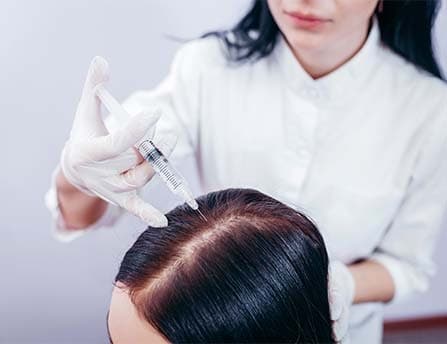
We offer platelet-rich plasma (PRP) injection therapy for hair thinning and hair loss. Your blood is drawn and processed to extract growth-factor-rich plasma, which is injected into the scalp. Those platelets prompt inactive or newly implanted hair to enter active growth.
Ready to talk to someone?
Book an appointment in the clinic or by telemedicine — or call us on +92 310 040 4444.
Book an appointment